Skip to course details
WOLOFACADEMY Explore the curriculum

THE A1A2 BEGINNER’S WOLOF COURSE

Learn Wolof.
Connect with
family & friends.

A self-paced, step-by-step course that takes you from zero to confidently speaking the basics.

  • Complete beginners welcome
  • Learn at your own pace
  • Unlimited access

14 Day Money-Back Guarantee

A CLEAR PATH. PRACTICAL TOOLS.

Your first words.
And everything to build on them.

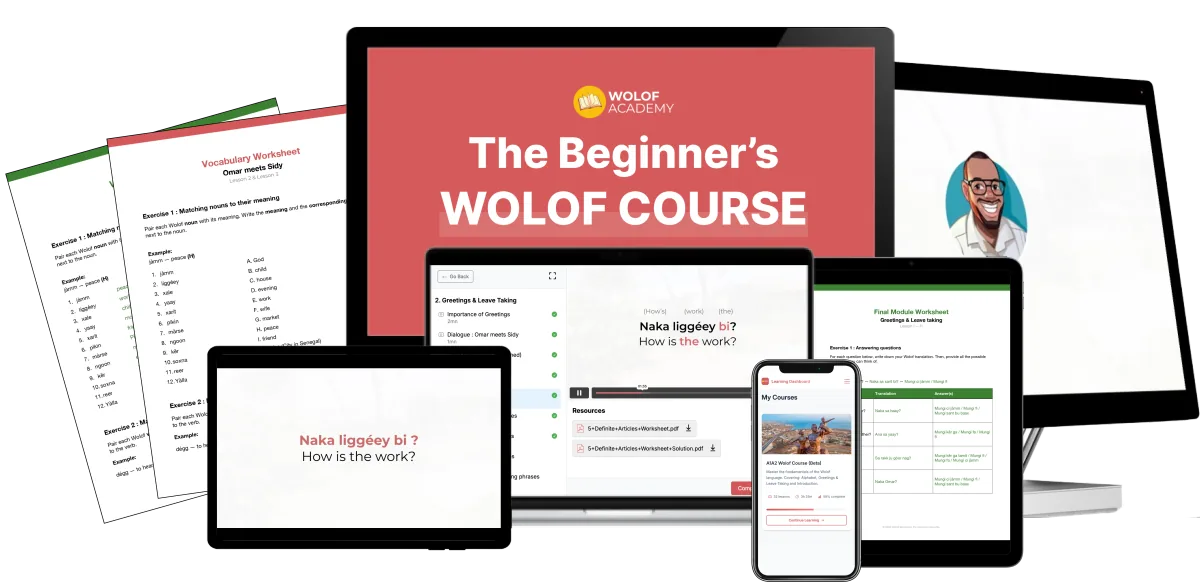
The Wolof course video lessons, worksheets, and learning dashboard on a laptop, tablet, and phone
48video lessons
22worksheets
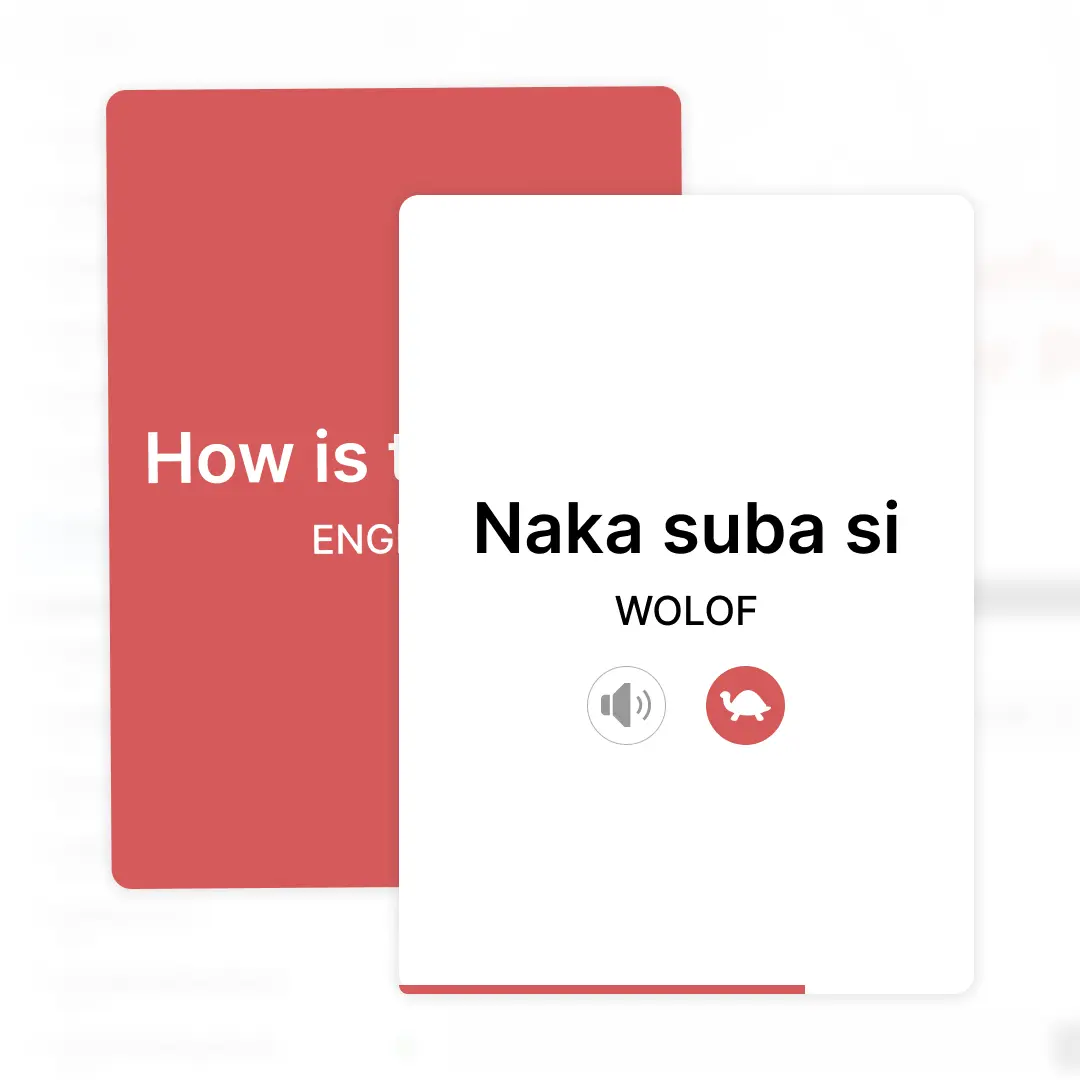
17flashcard decks
A step-by-step path, from your very first word

Do any of these situations
sound familiar?

If you're tired of feeling this way, know that it doesn’t have to be your reality anymore.

The path to real connection starts right here.

14 Day Money-Back Guarantee

Learning Wolof online
is a real struggle.

Learning struggles illustration
  • Finding quality resources online is like searching for a needle in a haystack

    with no guarantee the needle even exists. As a result, you spend more time searching than actually learning the language.

  • Most resources lack audio.

    Many websites only provide Wolof phrases in written form. You don't get to hear the proper pronunciation, leading to guesswork and potentially incorrect pronunciation.

  • No straightforward A to Z path.

    Learning a language can be challenging, especially when its structure differs from your native language. Most online resources only offer fragmented information, leaving you to figure out the learning path on your own.

Believe it or not,

I faced these exact same hurdles
several years ago.

Teacher Photo

In 2017, I had to teach Wolof to an English speaker online for the very first time.

Although I was fluent in Wolof as a native speaker, I had never formally studied the language, let alone taught it. So, like anyone in my position, I turned to the internet to find resources to support me in this endeavor.

But after countless hours scouring website after website, I barely found anything useful.

I was shocked.

Most of the good resources I found seemed to be designed by linguists, for linguists—filled with technical jargon and dense explanations.

To make matters worse, there was a glaring lack of consistency in spelling. A word might be spelled one way in one resource, only to appear completely differently in another.

It felt like all the knowledge was scattered across the internet, and it was up to me to piece it together.

I became overwhelmed and frustrated to the point where I even began to question:

"If I, as a native Wolof speaker, am struggling to find resources to deepen my understanding of Wolof grammar, how impossible must it feel for someone with no background in the language?"

This eye-opening moment inspired me to re-learn the Wolof language and work toward making the experience easier for others.

I collected every book I could find, downloaded every PDF I came across, and watched every video that even remotely related to Wolof.

At the same time, I was sharing everything I learned with my students and my growing online community.

I became a gateway—spending hours dissecting complex grammar, distilling it into simple, clear explanations, and teaching it in a way that avoided the confusing linguistic jargon.

Through this process, I wasn't just helping my students; I was also reshaping my own understanding of Wolof.

Katharina (Germany)
"I always look forward to the lessons with Ibrahima. He's very kind and patient and explains very well. He helped me to get into the grammar of Wolof language very well so i started to understand how sentences are made. I can really recommend him as a very good teacher who is enthusiastic about his language and about teaching it to others."

Learning Wolof shouldn't feel like
Scaling Mount Everest

Learning a new language can feel daunting, especially when its rules seem foreign and good resources are scarce. It’s easy to get discouraged, but it doesn't have to be that way.

I believe language learning should be fun, engaging, and something you look forward to.

Languages are meant to bring us closer to the people who matter most, not create barriers in our relationships.

Imagine the surprise and joy on your friends’ and family’s faces when you greet them in Wolof.

Picture yourself holding simple conversations, asking and answering questions with ease, and sounding like you belong. How would that transform your current life?

Here's the good news: this can absolutely be achieved.

All you need is the right guidance and a clear, step-by-step plan that starts with the basics, like the alphabet and pronunciation, then gradually builds to more advanced topics, such as sentence structure, while giving you plenty of room to practice and grow.

To succeed, you need a balanced mix of grammar, vocabulary, and cultural understanding. But above all, you need consistency.

Staying consistent is your part of the deal—but I can guide you through the rest.

Let me introduce you to:

The A1A2 Beginner's Wolof Course

beginner wolof course preview

The self-paced video course that guides you step-by-step through the fundamentals of the Wolof language, empowering you to start communicating confidently in Wolof.

After this course, you'll be able to…

  • checkmark

    Read and pronounce Wolof confidently: master the alphabet, vowels, consonants, and tricky sounds so you can read any word confidently.

  • checkmark

    Greet people naturally: use authentic morning, evening, formal, and informal greetings that show cultural respect and warmth.

  • checkmark

    Introduce yourself and others: say your name, where you are from, what you do, and ask others the same.

  • checkmark

    Talk about your family and relationships: describe who is who, use possessives like "my/your/our", and speak about family roles.

  • checkmark

    Use numbers with ease: count from 0 to 100, talk about age, and count everyday objects.

  • checkmark

    Express simple actions and states: say things like "I'm hungry", "It's hot today","My friend is sleepy", or "Jessica loves fish".

  • checkmark

    Build both positive and negative sentences with basic verb forms, ask yes/no questions and form questions about objects and complements.

  • checkmark

    Understand and join simple dialogues: whether meeting someone new or chatting about family life.

  • checkmark

    Sound natural and respectful: with culturally appropriate phrases and expressions.

By the end of the course, you'll have mastered beginner Wolof (A1) and begun developing early A2 skills.

You'll go far beyond memorizing stock phrases.

You'll be able to create your own sentences, ask and answer questions, and hold short but real conversations about daily life.

14 Day Money-Back Guarantee
Jemila (Canada)
"Ibrahima is a great teacher, and very knowledgeable about inner workings of the Wolof. I find his lessons fun, engaging and interesting. Would highly recommend him to those wanting to learn!"

What Makes this
Course Special?

The Curriculum

Module 1 The Alphabet

One of the first and most important steps in learning Wolof is mastering how to read and pronounce its sounds. That’s why this course starts with the very building blocks of the language: The Alphabet.

In this module, you'll learn how to confidently read and pronounce every letter of the Wolof alphabet—from the straightforward sounds to the more challenging ones.

By the end of this module, you'll be able to identify and differentiate between short vowels, long vowels, consonants, doubled consonants, and pre-nasalized consonants, giving you a solid base for reading and speaking Wolof with clarity and accuracy.

What's included:

  • Features of the Wolof Alphabet
  • Vowels
  • Consonants
  • Tricky consonants
  • Pre-nasalized consonants
  • Pronunciation Practice Activity #1
  • Pronunciation Practice Activity #2
  • Pronunciation Practice Activity #3
  • Useful Beginner Phrases

Module 2 Greetings & Leave Taking

Every encounter begins with a greeting and ends with leave-taking, making these fundamental aspects of social interaction.

In this module, you'll learn everything you need to know to greet people properly and take your leave with confidence. We'll dive into the cultural nuances behind these interactions and break down all the steps involved (and trust me, there are quite a few).

Specifically, you'll explore:

  • Different ways to greet someone based on the time of day (morning, evening, etc.) and context (informal, everyday).
  • The essential expressions for taking your leave.
  • Key grammar concepts, including the use of definite articles and basic question structures.

By the end of this module, you'll be ready to impress your family and friends the next time you see them by greeting them like a true native.

What's included:

  • The importance of greetings in Senegalese culture
  • Dialogue : Omar meets Sidy
  • Dialogue Explained : Omar meets Sidy
  • Useful Question Words
  • Definite Articles
  • Everyday Greeting phrases
  • Informal Greeting phrases
  • Morning Greeting phrases
  • Evening & Beyond Greeting phrases
  • People inquiry phrases
  • Leave taking phrases

Module 3 Introducing Yourself and Others

In this module, you'll gain all the tools you need to confidently introduce yourself, the person you're with, and ask meaningful questions about others.

You'll learn how to share details like your origins, where you live, your job, your family's background, and more.

Even more importantly, this module introduces key grammar concepts that are essential to your Wolof learning journey.

You'll dive into topics such as:

  • Subject pronouns
  • Question and answer structures
  • Identity verbs
  • And much more

By the end of this module, you'll be able to confidently talk about yourself and others, while mastering how to use subject pronouns to formulate questions and responses effectively.

What's included:

  • Introduction
  • Dialogue: Naomi Meets Ibrahima
  • Dialogue Explained: Naomi Meets Ibrahima
  • Introduction to Wolof Subject Pronouns
  • Introduction to Object Emphasis Pronouns (O.E.P)
  • Building Questions using O.E.P
  • Building Contracted Questions using O.E.P
  • Including the Subject in Questions
  • Building Basic Responses using O.E.P
  • Including the Subject in Responses
  • Expressing Identity Using O.E.P
  • Common Occupations

Module 4 Family members & Possessives

This is the longest module in the course and introduces some of the most important building blocks of Wolof grammar.

You'll learn how to talk about your family in detail: naming and describing each member, explaining relationships and feelings between people, and asking others about their families.

You'll also dive into important grammar concepts that are essential for expressing yourself naturally in Wolof. These include:

  • An introduction to Wolof conjugation
  • Stative verbs and how to conjugate them
  • Using object-emphasis and perfective pronouns with stative verbs
  • Numbers and counting
  • Forming and answering yes/no questions
  • Simple negation

...and much more!

By the end of this module, you'll be able to describe your family with confidence and express yourself in more complete, accurate Wolof sentences.

What's included:

  • The Importance of Family in Senegalese Culture
  • Monologue: Meet Khadim
  • Monologue Explained: Meet Khadim (explained)
  • Possessive Adjectives for singular nouns
  • Possessive Adjectives for plural nouns
  • Conjugation 101
  • Introduction to Stative verbs
  • Common stative verbs (72)
  • Using Stative verbs in the Present Tense
  • Introduction to Perfective pronouns
  • Stative Verbs conjugation with Perfective pronouns
  • Simple Negation
  • Counting from 1 to 100
  • Counting Things & Objects
  • Sharing your age
  • Common Family names

Resource Hub Additional Resources

In this section, you'll gain access to a curated list of resources, including content I've shared online and other valuable materials I've discovered, all organized in a structured way to support your learning.

These resources will enable you to explore beyond the main lessons while I work on developing new content.

Hafsa (Gambia)
"I haven't even realised my Wolof has scaled up until I had a conversation with my big sister in Wolof. And she was like "Wow hafsa! So you can speak Wolof like this ?"

Support Materials for
Every Step of the Way

Support Materials for Every Step of the Way

Learning a language isn't just about watching lessons—it's also about having the right tools to reinforce what you've learned.

Here's what you'll get to support your progress:

PDF screenshot

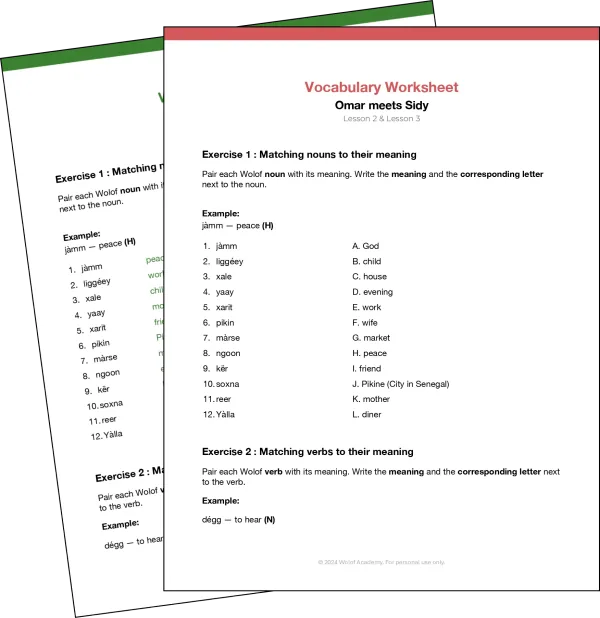
Worksheets & Solutions

Practice what you've learned with carefully designed worksheets, and check your understanding with included solutions.

PDF screenshot

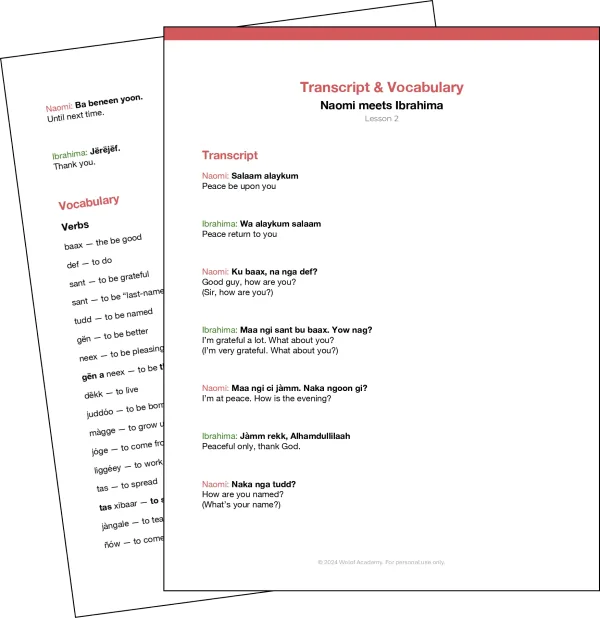
Transcripts, Vocabulary, and Phrases Lists

Every dialogue and vocabulary lesson comes with transcripts and carefully selected word and phrase lists so you can review, memorize, and put what you’ve learned into practice.

But wait…
There's more!

Enroll in the course and unlock these exclusive bonuses ✨

Ready to Start Learning?

Take the first step today and unlock the complete course package:

Payment plan

What's Included

  • 48 Video Lessons
  • 22 Worksheets with Solutions
  • 19 Transcript Sheets & Vocabulary Lists
  • 17 Digital Flashcard Decks (Bonus)
  • Duolingo-Style Practice Activities (Bonus)
  • Unlimited Access to All Future Updates
Pay in Full

What's Included

  • 48 Video Lessons
  • 22 Worksheets with Solutions
  • 19 Transcript Sheets & Vocabulary Lists
  • 17 Digital Flashcard Decks (Bonus)
  • Duolingo-Style Practice Activities (Bonus)
  • Unlimited Access to All Future Updates

TRY IT OUT, RISK FREE

14-Day No-Questions-Asked
Money-Back Guarantee

14-Day No-Questions-Asked Money-Back Guarantee

money back guarantee

I've put countless hours into crafting this course and I truly believe it will bring immense value to you. However, I understand that you might still feel hesitant or wonder if it's the right fit for you.

The only way to know for sure is to experience the lessons for yourself.

That's why I'm offering a 14-Day Money-Back Guarantee.

When you enroll, you'll have 14 full days to explore the course, dive into the lessons, and decide if it meets your expectations.

If it doesn't, all you need to do is send me an email, and I'll happily refund your entire payment—no questions asked!

Enrolling today isn't a final commitment.

It's simply giving yourself the chance to make an informed decision by trying the course and seeing how it can help you get closer your goals.

Got Questions?
I've Got Answers!

What level of Wolof do I need to start the program?

None! This course is designed for absolute beginners, so you don't need any prior knowledge of Wolof to get started.

Do I need to know basic grammar concepts like pronouns and objects?

Not at all! I'll explain everything from scratch, including any grammar concepts you'll need to know. The course is beginner-friendly and assumes no prior understanding of linguistic terminology.

Can I study at my own pace?

Absolutely! The course is entirely self-paced, allowing you to watch lessons, complete exercises, and review materials whenever it suits you best.

How long will I have access to the course?

You'll have unlimited access to the course, meaning you can return to it whenever you need. Whether it's next week or next year, the content will always be available for you to revisit and continue learning.

What if I enroll and realize it's not the right fit for me?

No problem! The course comes with a 14-Day Money-Back Guarantee. If it's not what you expected, just email me within 14 days of enrollment, and I'll issue a full refund—no questions asked.

Will this course make me fluent in Wolof?

This course is focused on building a strong foundation in Wolof, equipping you with the skills to have basic conversations and understand the language's structure. Fluency depends on consistent practice and exposure over time, but this course will set you on the right path!

Does the course cover cultural aspects of Wolof-speaking communities?

Yes! In addition to language instruction, the course includes insights into Senegalese culture, helping you understand how Wolof is used in everyday life.

How much time should I dedicate each week to the course?

That's entirely up to you. Some students spend 2–3 hours a week, while others dedicate more time. The more consistent you are, the faster you'll see progress!

I'm interested in Gambian Wolof. Does the course cover that?

Not specifically, but from my experience, Gambian Wolof and Senegalese Wolof share the same grammar. In fact, many of the resources I've used in the past were created by Gambian authors. The main difference I've noticed is the addition of 'a' to certain words. You might want to supplement the course with a Gambian dictionary for those nuances.

Your Path to Learning Wolof
Starts Here.

Your Path to Learning Wolof Starts Here.

Take the first leap today and unlock the complete course package:

Payment plan

What's Included

  • 48 Video Lessons
  • 22 Worksheets with Solutions
  • 19 Transcript Sheets & Vocabulary Lists
  • 17 Digital Flashcard Decks (Bonus)
  • Duolingo-Style Practice Activities (Bonus)
  • Unlimited Access to All Future Updates
Pay in Full

What's Included

  • 48 Video Lessons
  • 22 Worksheets with Solutions
  • 19 Transcript Sheets & Vocabulary Lists
  • 17 Digital Flashcard Decks (Bonus)
  • Duolingo-Style Practice Activities (Bonus)
  • Unlimited Access to All Future Updates